Pages

Wednesday, 28 September 2016

How to Thrive Online


I watched this (50 minute long) video of Howard Rheingold, cyberculture expert and academic, on How to Thrive Online.  He is the author of the book Net Smart which outlines 5 literacies that we need to not just survive, but to thrive online.  While not specifically directed to young learners, it does very much reflect the literacies that we all need online and so I think outlines the critical literacies that we need to continually teach our learners.
He calls these literacies  - attention, crap detection, participation, collaboration and network smarts.
Attention refers to the fact that digital technologies  are distracting but Rheingold claims that we can train ourselves to overcome distractions by attention to filtering what is useful and what is not.  He quotes Clay Shirky as saying there is no such thing as information overload - it is filter failure. History has taught us this has happened before when books first arrived on the scene.  We learned to cope with this overload by bringing in alphabetisation, indexes, subject headings, taxonomies, reference books, encyclopaedias, authors, critics, and editors.  So now we need to bring in new strategies to help us filter, and make conscious decisions to use them.
Crap detection is the next literacy (critical consumption is the polite term).  This teaches us how to recognise hoaxes and incorrect information.  We need to learn how to "search to learn", validate online sites by looking for authors, triangulate any information, seek multiple viewpoints (if no-one annoys you, you are in an echo-chamber).  Our learners find it hard to be critical consumers without learning those skills - this is where they need support to discard and bullying incidents, distinguish between what is real and what is opinion and grow all of the attributes of self worth as they do in real life.
Participation is about building your own online presence as a leader and he refers to Ross Mayfield's Power of Participation graph.

Collaboration is working together on a common purpose - build your community around this, and build networks rather than groups.  Groups are tightly knot whereas networks are a lot looser.  Use collaborative intelligence to work as a powerful group.  For example crowdsourcing how to solve a problem.   I am reminded of Alec Couros at ISTE talking about learner-led activism.  He gave us guidelines in how to find a good cause to support and lead on social media.
Finally the power of Network Smarts - be aware of the information that you post online, the person that you paint, the picture that you want others to see.  Our networks are in our pockets, and we should build on our social capital, our network capital.  We are more likely to get back if we contribute positively.
My question to you all is - are you thriving online?  Can you give me some examples of how your answer is illustrated?
Talks At Google. (2012, May 02). Howard Rheingold: "Net Smart: How to Thrive Online" | Talks at Google. Retrieved from https://www.youtube.com/watch?v=vajSK1jV56A

Tuesday, 20 September 2016

Teachers Stuck in a Tug of War

Having just watched Sir Ken Robinson's latest video about the need for a change in education, I am once again prompted to write about the urgency for understanding among educators in our schools and our society.   You see, leaders and teachers are stuck in a tug of war between educating our learners for the future and educating our learners for success in our standards driven system.  Listen to Sir Ken here.


Children are natural learners.  Sir Ken talks about children as natural learners and how "education" is at odds with this.  He thinks that school wears away at the curiosity of children, until they become disengaged and bored.
He thinks that the human factor has been removed from education due to the emphasis on competition, standardisation and testing.  He supports the involvement of a movement called GERM - global education reform movement - to remove the industrial element from education and replace with an organic one. He states that the GERM approach is "command and control" whereas he believes it should be about climate control - creating the right conditions for learning.

Our education system is like industrial agriculture.  His comparison of education to the industrialisation of agriculture - with the emphasis on yield and outputs having a resultant big price to pay (environment and soil erosion) - points to the idea that you need to get the natural process of teaching and learning right.  We have to create the optimal conditions in schools for each child to thrive as an individual, not as one of identical size, shape and colour.  We need a cultural climate for learning.

Leaders have a role to play.  As long as our society values results in standardisation, this will not change.  I have heard school leaders saying that they do not see the need to change because they are successful in terms of "results" - these being NCEA or national standard results.  They are traditional and that is what their parents want.  Parents want their children to be educated in the same way that they were and they want them to achieve well in standardised tests.  Sadly, the future will not look like it did for them.

Moral purpose:  I do believe that leaders need to think about the moral purpose of education, and start educating their school communities about the moral purpose of education, as well.   We need to prepare our learners to survive AND thrive in the future world.  Our learners need to develop their own personal strengths and passions so that they can find their place in the knowledge society.

Tuesday, 6 September 2016

Sharing - the Moral Imperative for Teachers

Along the same lines of the last post regarding Tweeting, this video of Dean Shareski doing an online keynote sharing is one of the most inspiring I have seen for a while.  He talks about teaching being sharing.  It is 25 mins long, well past the 10 min videos that I usually recommend but so many ideas relevant to teachers in today's' classrooms.  Please give it a watch if you have 25 spare minutes in your day.  Thanks to Viv Hall for sharing this video with me.  And thanks to Dean for sharing the keynote.
             

Sunday, 4 September 2016

Twitter as a Teaching and Learning Tool

I am not a great tweeter.  I tweet out my blog and, occasionally, I tweet out other useful resources that I like and think other educators might like, too.  However, I do use Twitter in other ways.  If I want to get any ideas, inspiration or help from whoever I can, I often turn to Twitter to search for hashtags about my topic of interest.  And I follow about 600 people who are mainly inspirational educators so if I want to browse their feeds, it is easy to go to my Tweetdeck and watch what is coming through to keep up to date with the topic of the moment.  
Using Twitter. When I am at a conference or meeting, I sometimes take photos and notes on Twitter to make a set of notes which I can refer back to.  I also share my notes using the hashtag of the meeting and if I miss anything, you can be sure that someone else will have captured that and I can crowdsource the missing bits.  I do see the value in Twitter as an awesome resource pool for educators like myself.
Social Tweeting: Some people are engaged a lot more than me, and use a hashtag to share ideas around different topics in education. Some of them have regular meetings to discuss current events in education eg  #edchatnz  and #ldrcahtnz I can go to those feeds by simply going to Twitter and searching for the hashtag.  I can even do do what we call "lurking" - watching the feed and gathering ideas and resources as the conversations unfold but not actively participate. Sort of like being in the back row of a lecture theatre.
Twitter in the Classroom: Some teachers also use Twitter in the classroom, for example #KidsChatNZ and #readaloud.  Check out those links for more info on how.
What I have found out: I have been doing a little looking into Twitter for a paper I am studying and decided to do a little informal research through a survey. Over two days, I received around 50 responses.  Here are some of the results of that.
It is obviously pretty positive for these people, so I am actually surprised that my peers and tutor do not see Twitter as a tool for teaching and learning.  I also asked for some ot the ways in which teaching practice had changed.   Here is a doc that lists the results of this question.
Changes in Teaching In a broad summary these were: -   Inspiration, resources and ideas, collaboration, connectivity(esp for isolated schools), latest thinking around education eg play based learning, PLN, , different perspectives, and also like minded people, validation, change in leadership, challenges thinking (out of comfort zone), learning from others, opened door to opportunities, short and sharp, horizontal connections, authentic audience, access to experts, different perspectives, shared learning with parents, reflect, exponential improvement, makes me question more, affirmation.

 Changes in Learning: I also asked in what ways students' learning had changed (if any change) and here are the results of that question.  In broad summary these were Connected, globally and nationally, collaboration, teaches digital citizenship, authentic audiences, projects, purpose to learning, communication with teacher, better engagement, access to experts (Kevin Mealamu, Kid President etc) , encourages reflection and feedback, visible learning tweeted out using photos, videos, alerts students to changes on VLN website, participation and learning from #kidchatnz #readaloud

What can you say to the doubters? 
Of course I haven't surveyed any teachers who have joined twitter and then gone away from it.  It wasn't exactly a scientifically designed survey but I just needed some ideas on how people were using it and why they found it valuable.  93% of those who answered the survey follow #edchatnz so if you are just starting out that might be a good place to start.  Have a look at the link to the #edchatnz  website to see when those discussions take place.

Research: It is quite difficult to find empirical research about the benefits of using Twitter in primary and secondary classes.   My tutor is a sceptic and says why would you use it if it is not proven to promote deep learning.  But I am guessing it is a relatively new tool in class and also difficult to directly attribute increased achievement (AKA national standard results) to the use of Twitter. 
What is deep learning and does Twitter support it? Michael Fullan is working on deep learning pedagogies and I am pretty certain that he would think that Twitter would enable deep learning as the definition of deep learning in the glossary of the NPDL website is:  
Comprehensive learning that includes a range of skills and attributes related to human flourishing, e.g., creativity, connectedness and collaboration, problem solving, wellness, and the capacity to establish and pursue personal and collective visions. An initial summary of deep learning skills might be grouped within the following realms: character education; citizenship; communication; critical thinking and problem solving; collaboration; and creativity and imagination.
My question to you: It seems to me that teachers and learners are flourishing in creativity, connectedness, collaboration and problem solving through this medium.  So what do you think, is Twitter a useful teaching and learning tool?  


Monday, 8 August 2016

Digital fluency - what does that really mean?

There has been a lot of educational chat around "digital fluency" lately as the Ministry of Education has made it one of the areas of national priority in professional learning and development in education.  A lot of principals and teachers are asking me what that really means.  They are keen to understand and once they hear about it, access the professional learning that the ministry will offer.

This pdf is somewhat helpful in understanding the big picture around how digital fluency will be implemented and embedded but many leaders and teachers want to get into the nitty gritty of what it means in their schools and classrooms. A lot of teachers have started their journey to becoming digitally literate - that is knowing how to use digital technologies, but fluency implies a bit more than that.

Think about how we view fluency in a language.  Fluency implies that you speak the language like a native.  Now I am not going to enter into the digital native vs digital immigrant philosophical argument (because I don't give that any weight at all - you are either an inexperienced or experienced user of digital technologies and when you were born really makes little difference) but language fluency helps us understand digital fluency.

If  you are literate in a language, you know what the words mean and can translate them.  If you are fluent in a language, you are able to slip easily into using that language and out of it.  You are able to use words that convey a different nuance or meaning quite naturally.  For example, if fluent in Maori language, you would know in what contexts to use the word "aroha" from the Maori language.  Although I know what the word "aroha" means in a general sense, I know that fluent Maori speakers use this word in a number of different contexts, with a lot of different nuances, and as I am not a fluent Maori speaker, I cannot do this naturally.


So, being digitally fluent means not only knowing what the tools can do (digital literacybut also being able to move in and out of using digital tools as easily as breathing or speaking a second language fluently.  You select the right tool for the job at the right time.  You use digital technologies safely and easily.  You search for and examine different sources of information for their validity.  You create using digital technologies.
Derek Wenmouth from CORE talks about digital fluency being "an infusion of technology" in the classroom, and "unconscious competence" in its use.   Let's imagine what that might look like in the classroom:

  • I would see teachers and learners who know their passwords and use them regularly (not always common, even in these days) and/or they use online password apps to manage this.
  • Online collaboration would be commonplace.  Not just sharing but working together on a common aim with purpose, using tools like google docs, padlets, skype, blogs and video making etc
  • I would see teachers and learners bookmarking and sharing their bookmarks to various working groups (social bookmarking), colleagues and students.
  • Personalised learning (not teacher directed) would be supported through digital structures and processes to scaffold students into becoming the lifelong learners that our curriculum framework desires.
  • I would see app smashing used often and in an uncontrived way,  building knowledge and creating new digital products for online collaborative critiquing and evaluation
  • Multimedia creations would be commonplace as evidence of learning, but also in engagement, expression and representation following principles of UDL (Universal design for learning).
  • Students would have agency (control and choice) over which device they used for learning.
  • I would see teachers and learners regularly following their favourite or most useful websites and blogs using RSS or email feeds.
  • Digital citizenship would be embedded across the whole school community, including appropriate posting and commenting on blogs by learners, whanau and teachers.
  • Teachers and learners would be digital citizens and not be using any online resources without permission and attribution.
  • Editing - adjusting, trimming, adding value to learning and knowledge would be a natural and seamless, ongoing process for learners and teachers.
  • e-portfolios would be totally integrated with everyday learning and personal and group reflections would be commonplace and often open to others - a metacognitive activity to really show deep understanding and learning.
  • Searching, locating, sorting, evaluating, tagging and using online resources would make every researching task easy. 
  • Engaging in online communities, networks and social media like twitter through multimedia would ensure quick and timely feedback around any questions 
  • Linking - learners would be working with other learners nationally and globally, making connections and knowing the right people to answer the questions would be part of the natural workflow.
So these are just some of the ways that digital fluency might manifest itself.  It is not enough to know how digital technologies can be used......you have to use them, blend them into your practice every day.


Friday, 29 July 2016

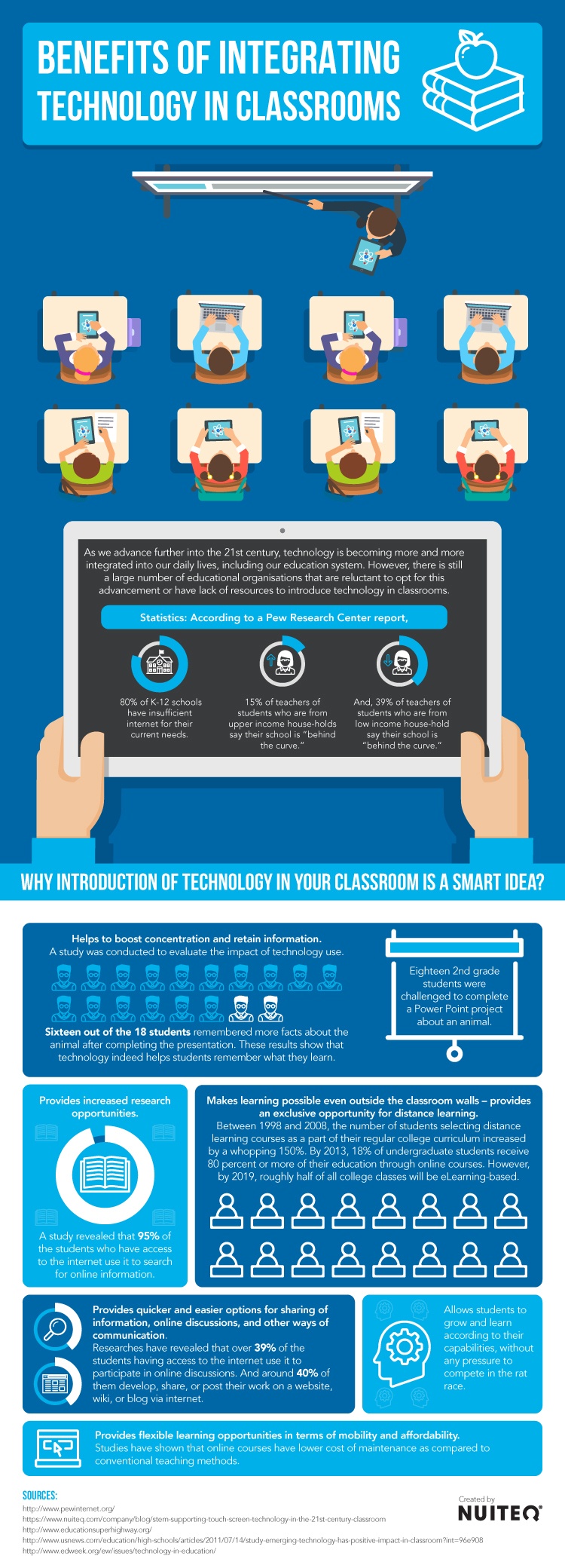
What a Terrible Infographic!

OMGosh can't begin to tell you how bad the content and presentation of this infographic is, considering it is supposed to be representing the benefits of integrating technology in classrooms. Students sitting in rows in a classroom. Really? Teacher at the front - really? How about some modern learning environments? Powerpoint? Really? How about creating their knowledge on a presentation of any kind? Saying 95% are using internet for research - how limiting, how absolutely underwhelming use of the internet , what about activities for learning? (Reminds me of the OECD report that said screen time was bad for students' achievement. Turns out the ones having 4+ hours of screen time AFTER SCHOOL were the ones doing not so well.) Differentiated learning is reported on in a very small corner of the poster - and what about personalised learning? Big let down, this infographic. Benefits of Integrating Technology in Classrooms Infographic
Find more education infographics on e-Learning Infographics


Saturday, 23 July 2016

The Power of A Tweet

I've been feeling a bit down.  On a personal note, my mum died last month.  She was a good old age, nearly 90 and she just seemed to decide it was her time.  Everyone's mum has to die and I am grateful that she kept in pretty good health until the last 3 weeks.

On the work front, I am presently jumping through a series of new hoops to prove that I am a capable facilitator, as the Ministry of Education has decided that all facilitators working in New Zealand schools for MOE centrally funded professional learning must be accredited.  This means showing evidence of meeting the criteria that they have formulated, to be placed on a website so that school leaders can select who they wish to work in their schools, and so I am putting together a Word document (which is the MOE's preferred version of a facilitator's e-portfolio) to show that I meet all 13 criteria.

It is similar to teacher registration - having to show that you meet all 12 of the PTCs except this is not a process over a year. Rather, it is capturing a story that you think shows evidence of you meeting the criteria.   So you tell your story and then try to match the criteria to parts of the story.  Which brings you to a point where you try to elaborate on why it shows evidence of practice.  Which disrupts the flow of the story.

It has meant a lot of teeth gnashing and hair pulling as I rewrite the story trying to forge and fashion a readable piece which truly reflects the way I work.  I have nearly thrown in the towel and said, that is it! No more!  I have cut up the criteria and printed my story and physically sellotaped the criteria onto the story and then in frustration at seeing the criteria met in many other parts of the story, I have screwed that version up, too.

I don't like working this way - I much prefer the powerful multimedia representation of my work that a website like Google sites, or Myportfolio, or a blog can show.  I have come to a dead slow, deccelerating, grinding, and demoralising halt without feeling like I have really represented myself.

This morning I woke to a tweet from the awesome Barbara Bray (see below)
and I thought to myself - wow - that is me! Barbara Bray thinks I am an Amazing Leader!  And in such awesome company.  Oh, the power of that tweet.  I woke up properly and thought, this is all wrong.  The story of my practice should be a celebration of my work, not a dirge.  So I am going to attack it again with a new vigour.  I don't know that it will improve it but the power of that tweet has been enough to inspire me to blog out about it.(I had come to a dead slow deccelerating grinding halt on the blogging front, too).

So thank you, Barbara, for reminding me that praise is so powerful in our lives and in the lives of our learners.  I am reminded of the wise words of a former principal of mine (thank you, too, Josephine!) - appraisal should be all about praise - that's where the word comes from and we should never forget the power of improving our practice through praise for work done well.