Pages

Monday, 31 March 2014

Goldilocks can teach educators about learning.

I learn about hundreds of new things every week.  I peruse a list of items, articles, how to's and latest news on my reader "Feedly".  (It used to be Google Reader but sadly they dropped that.)  When perusing, the trick is to filter out what is not immediately useful, and store other stuff somewhere (usually in Diigo) for future reference in the hope I can remember it when the time comes.  Tags are great.  They help you search for stuff that you may not immediately remember what it was that you are thinking of.  Does that even make sense?
Another trick in my job is not to overload other people when it is not useful.  This is called "PD just in time."  You are much more likely to remember stuff when you have to use it for some specific purpose.  The same applies to learning with students.  Too much stuff becomes boring and pointless unless you are going to use it.
Our school curriculum in New Zealand is great.  There is so much scope to choose contexts that will be relevant for every student.  To personalise the learning, we need to use digital technologies.  This allows students to learn along their own pathways but it does add to the teachers' burdens.  When is "not enough" guidance, when is" too much", when is it "just right?"
I have been mulling over this question this morning, in response to an educator, Kevin Schindel, who in his blog on A New Class Project reflects whether some educators trying to develop 21st Century skills rely too heavily on the technology to be able to take over the role of the teacher.
I also read a blog by Charlotte French on "Student Agency vs Student Anxiety" this morning which really asks the question 'How much should a teacher really let go?'.  Her year 13 students want the right answers rather than having to construct the answers themselves.  Of course, they are preparing for NCEA assessments, so of course they want the 'right' answers.  Just how much does assessment detract form solid learning.  Another similar vein was raised by Heather Eccles in her blog "Good Results Do Not Necessarily Mean Good Teaching" and I could not agree more.  I just have to share this video.


Probably the 5 minute university is just not quite enough.  But how much is too much?  Are we expecting too much of our teachers?  Their roles as facilitators of learning requires them to be educated and trained in their fields, adept with digital technologies, and really overseers of the whole class of learning pathways every single year.  That is a pretty big job, don't you think?

Friday, 28 February 2014

Principals, Schools and Communities Held to Ransom

What is the problem? As I go into a lot of schools across the country, it is evident that there is a real problem holding up progress for the successful implementation of digital technologies into classroom practice for learning. This problem is the source of a mountain of barriers that educators come to when they find they they don't have access to all the resources that they need in the short time that they have for preparation or learning how to use a new bit of software.
These barriers have been put in face by their "friendly" technical staff. 
Now I must make it clear from the outset that not all technicians are tarred with the same brushes.  There are some fabulous technicians out there whose businesses are booming because they make digital technologies so easy for teachers and principals.
But there are too many who do not. They might be school based or they might be local or distance companies who hold the passwords and keys that the educators and their learners need.  I am not talking about firewalls which are absolutely necessary to protect students. I am talking about the holding of the balance of power in the school when it comes to using digital technologies for learning.

Some examples I have personally encountered in schools are:
  • Technicians advising and pushing schools which devices to buy, often whole sets of tablets, or only certain platforms that they can configure and maintain, and sometimes devices which are just not suited to learning.  Schools are at the mercy of these sales-oriented people pushing their own products and planning their future business around ongoing maintenance issues.
  • Technicians advising which software to use for learning including one who said that Myportfolio should not be used as it was too difficult to set up in the school.
  • Technicians preventing teachers from being administrators of the TELA laptops that they use. (And sometimes advising principals that this is the right thing to do.) Then teachers are unable to download software for their printers at home or any programme that they would like to investigate for use in the classroom. And, what a coincidence, the technician can charge for the time to install these programmes for the teachers. If you sense a touch of cynicism there, you are on the right track.
  • Technicians being the only people administering passwords for teachers and students so that no one can get on the system unless they are around AND technicians not providing passwords unless personally advised by the principal. 
  • Technicians locking up servers and software with passwords that they fail to release to principals, and then leave, when they fall out with the school personnel, leaving all systems locked up and tied up so tightly that they school has to spend even more $$$ on new technicians to untangle the unholy mess.

Why it is wrong. For a start technicians are not teachers for the most part - why would they feel they should choose the right products for learning? The teaching professionals are the ones who should be allowed to do this.  Sure, show them how things work, but give them the opportunity to compare and contrast before they make their decisions.
I just don't get it.  There is a relationship of trust between a school and a technician or tech company to do the right thing when you are paying for their services.  Its like paying for a painter to paint your bathroom.  You trust that the painter will use his expertise to allow you to choose the right paint, also the right colour of paint, offer to you to include a fungicide with the paint and recommend to seal the bathroom beforehand to prevent water damage so that down the track you don't find that the paint peels off in the humidity or gets covered in unsightly mould.  You don't invite that same painter back to do other rooms in your house if you find he stuffed up first time, just went ahead and painted the bathroom his favourite colour and didn't put fungicide in it because you didn't ask for it.

What should happen.
Principals:  Trust your teachers. Ask around other principals and teachers outside your schools about the effectiveness of certain devices.  Don't jump on the local bandwagon of getting a certain device without some thorough research on alternatives.  Get a variety of devices - that is what students will come across when they go into the workplace.  Join the VLN or twitter and start asking questions across New Zealand.
Teachers: Ask for (and demand) full access to all software you want to use for learning (You wouldn't accept a textbook in your class that had some of the pages bound up so you couldn't even see them let alone judge if they were suitable for your students.)  Form networks with other teachers from other schools to see what they use and what barriers there are.  Join the VLN.  Start tweeting and asking questions.
Technicians:  Build your business around making things work for teachers and schools, not tying them up so you are the resident "expert" who must be consulted at all times.
I am not saying all technicians are the same.  I am not saying they even do these things knowingly and  deliberately in some cases.  What I am saying is that technicians are the key people in making systems workable for schools, principals, and teachers, and they should be doing their utmost to make access to technology for education a piece of cake, not an ongoing source of income for their own ends.
I am really interested to know if you have come across this problem. 


Sunday, 2 February 2014

Copyright

There's a new round of interesting challenges flooding Facebook at the moment.  It involves sharing an artist's name and the recipient (or liker of your post) has to find a work on Google by that artist and put it up on facebook and the first person who likes that artwork, receives another artist's name to continue the game. I guess its kind of like a chain letter.
I like lots of different art, so was tempted to join in, and then realised the difficulty in getting permission to use the images so pulled out.  What a plonker they probably think I am.  But it really is a dilemma.  How can I go round espousing the responsibilities of digital citizens if I don't play by the same rules?
The images on facebook are sometimes directly from the artist and usually require specific permission.  Sometimes they have been copied - and then who owns the rights?  Is it the original artist who may or may not have given permission or is it the copier who may have used it and adjusted it in some way?
And then there is the issue of all the shared jokes and stories.  Are we allowed to share them?  What a can of worms!
Creative Commons, I hear you all saying.  But these copyright-free or otherwise images do not often contain the very art that you desire.  I also need to learn a lot more about how long after death copyright is still an issue.
A hint that I can give about searching for suitable images: Make sure you search images using google Search Tools that give you appropriate permissions.
And when you find an image that suits you, check again on the image details, by visiting the page the image is sourced from.  You may find that all rights are reserved, like in this one.
It is not as straight forward as you would hope.  Dammit!

Friday, 31 January 2014

Blog Envy

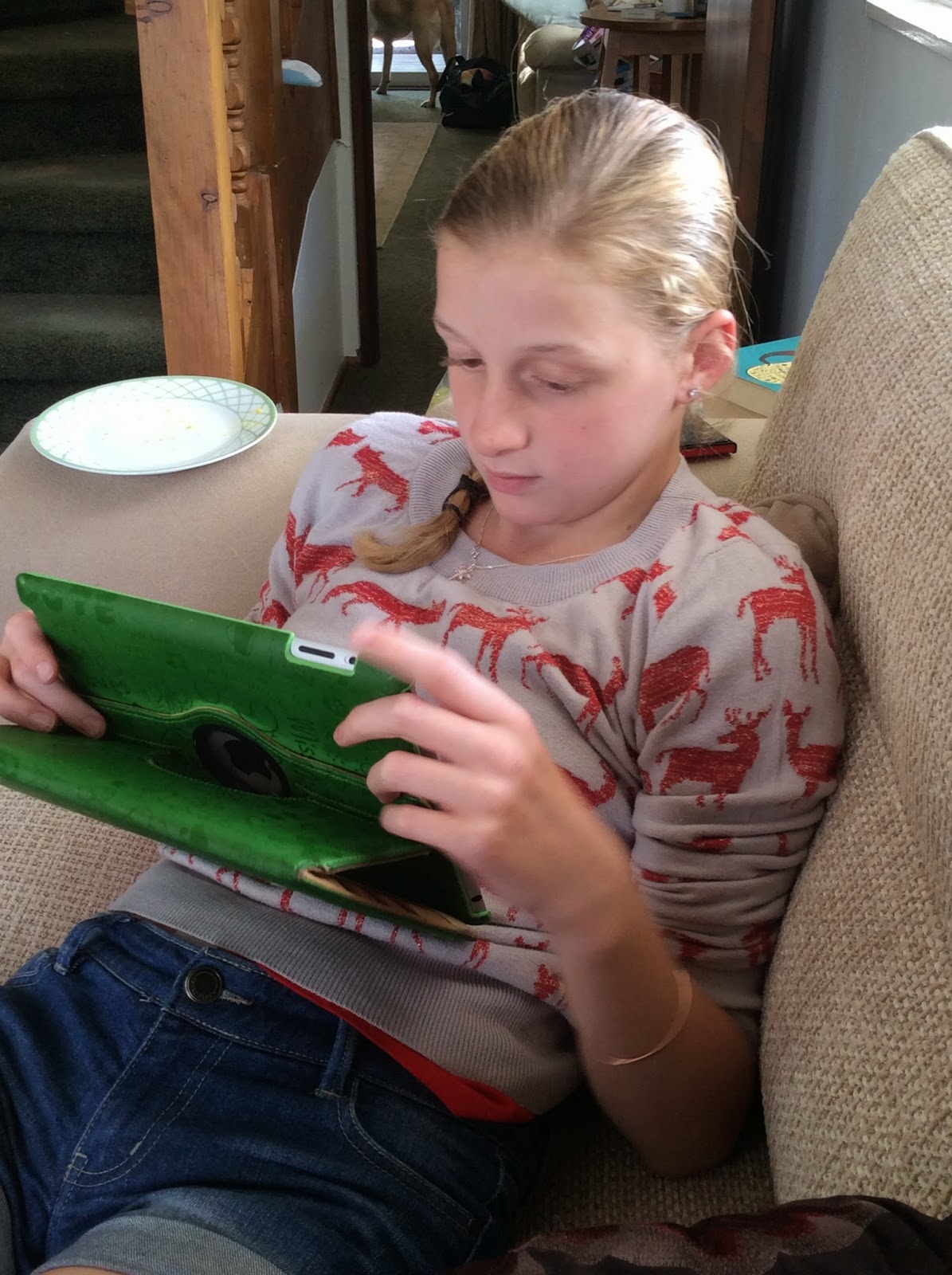
I introduced my granddaughter to blogging over the holidays.  Her mother is off touring in the USA and I thought it would be an ideal time for the two of us to work on improving her writing which her teacher tested for and judged (triangulated, no doubt) in a snapshot at the end of the year as "Below the National Standard".  Shock, horror!  
So drawing on what little I know about "writing for improvement", we decided to set up her ipad with Blogpress and encourage her blogging with the aim of writing to an authentic audience.  Subject matter abounds in the holidays.  "Write about your holiday experiences, share with other people and see what they have to say," I urged her.  Here is the resulting blog - Hunter's Blog


Initially, I had hoped for 20 views for her blog at the maximum, after all it takes time to build an audience and even more time for the "authentic audience" to respond with some comments.  That seems to be a common theme across schools.  I wonder who has seen a blog from a successful blogger at intermediate level in New Zealand so that Hunter can compare and contrast?

What I found was her audience was twice as big as mine from the beginning.  Oh, Blog Envy, I think it needs to be number eight of the deadly sins. I have begun to question why I do not have a larger audience.   Is it because she is 12 and I am 60? How can I cast my net further?  Is my writing boring?  I suppose I do ramble on about education a lot, is it just something most people are not interested in?  Oh well, I suppose it comes back to the purpose of blogging.  For me it is reflective.  Having said that I certainly do want to share these thoughts with people, after all , its not  much fun being an island, is it?

So I can gnash my teeth for the next five months but really it comes down to what have I learned from observing the changes in her attitude to writing?  

  • I learned it makes a real difference to be able to use technology and not have to rewrite to the teacher's satisfaction, a multitude of edits in handwriting until your hand aches.
  • I learned it really does make a difference if you know someone else is going to be reading your writing.  There is a sense of urgency in wanting to edit and get it right.
  • I learned you really have to think about what you believe (actually I knew this already but it was pleasing to watch this process going on in the young mind)
  • I learned you can really make it "your own work" with adding your own images.  Adding the right photos has been a fun part of the process, as well as giving a sense of ownership.
  • I learned that there are so many teaching opportunities when children write blogs, like the digital citizenship issue that came up when my granddaughter wanted to use an image from Google, (you shouldn't just help yourself to other peoples pictures and, yes, cartoons belong to people, too).
  • I learned there are lovely people out there who can really make a difference in a young girl's life by commenting and encouraging and supporting blogging.  
  • I learned you really can enjoy doing homework in the holidays (actually I knew that already, too, but someone else didn't.)


Yes, Grandma learned a lot these holidays. And I think Hunter did, too. Blog on, Hunter!


Tuesday, 7 January 2014

A response for Manu

This blog is in response to the stunning +Manu Faaea-Semeatu's invitation to start the year rolling, with 11 random facts about me:

  1. I ran away from my first husband.
  2. I ran away to Hawaii 15 years later to get married to my second husband.
  3. I am not very good at running, actually
  4. I spent nearly a year in and out of three different hospitals when I was 5 with osteomyelitis in my foot and Charlotte Dawson's father (adopted) was the bone specialist who finally fixed it with a bone transplant from my hip.
  5. I started my working life as a microbiologist specialising in the study of viruses in sewage
  6. I have never once in my whole life been slim.
  7. My maiden name is Gulliver
  8. I love summer.
  9. I once won the women's shoot at clay bird shooting at my father's club.
  10. I am naturally a brunette
  11. My new neighbour is Mark Lundy
Pretty random, huh?

And now the answers to Manu's 11 questions.

  1. If I had the power to create change in education in Aotearoa, I would have every educator and educational institution implementing the use of technology in their classrooms to allow every student to live and breathe and embody the six themes of future oriented teaching and learning through the power of digital technology.
  2. My most influential teacher in high school was my 6th form English teacher- Mr Allen- a man with one arm.  It is so long ago, I nearly forgot his name but he talked to us about his own life experiences and built the relationship so well that I strived to do my best to please him with essays and tests. I cannot remember what he said to me personally, his remarks were always directed to the class as a whole.  He was a great story-teller.
  3. The Christmas card or the present?  It is neither really.  It is the thought behind the present be it small or large.  Why did you give me this?
  4. My racing partner would be my Dan,
    because he knows how to analyse physical situations around us and he is strong and fit!!
  5. My specialist topic on Mastermind would be plants.  I like plants, I like their biology, their life cycles, their forms,their many uses and their never understated importance to us in the world. 
  6. The NZ road rule that should be omitted - push bikes should not be allowed on car and truck roads - they should have separate roads or lanes.  I fear for their riders' lives.  I think bike riding is awesome - great to keep everyone fit and fun but it is too dangerous to go on NZ roads. Don't stop bike riding though, just build separate byways for them.
  7. My fav app at the moment is Bitstrips just because it is the holidays and fun.  I am nearly over it though. 
  8. Facebook for social media, Google+ for work related networks.  Google+ has less fluff with it. Twitter for instant access to pd. Search with your desired hashtag.
  9. Reasons for blogging? - reflections clarify thinking.  Helps you focus on what is important - whether it be work, play, friends or family.  So that is the diarying aspect.  There is also the sharing aspect, and getting feedback - so nice to know there are other people out there who value what you have to say!
  10. A four day working week? Yessirrreeee!! 
  11. Top of my bucket list is to tour all 50 of the US of A!  Such a beautiful country, so many diverse people, so many weird and wonderful places to visit.  It would take me about 18 months I think.  Have only been to 16 so far.
I am not so sure about nominating 11 bloggers.  I have been nominated for other blog writing exercises such as this and it can become a bit of a trial!!  Maybe I will just wait for 11 bloggers to volunteer responses and answer the same questions that Manu asked in her original blog.

The good thing is, I have now done my first 2014 blog!!  Thanks, Manu!


Saturday, 21 December 2013

What does education look like for your child?

I haven't blogged since October - lots of ideas swirling around and all linked to one big idea - what should education look like in New Zealand?

The most significant reading I have done this year is Supporting Future Oriented Teaching and Learning - A New Zealand Perspective by Rachel Bolstad and Jane Gilbert, with Sue McDowall, Ally Bull, Sally Boyd and Rosemary Hipkins. In October 2012, Curriculum Update 26 summarised the six main themes of future oriented teaching and learning, so all teachers should be familiar with how education will look based on the research done by these researchers.

I say, should be familiar, because sometimes educational concepts are slow to filter through to teachers at the coalface. As I read this blog tonight called "Same Old, Same Old" by Tom Whitby, I reflected on why changes are so slow. Whitby says that "There is no longer a choice as to whether or not educators should incorporate technology tools for learning into education. That boat has sailed, that train left the station, that genie is out of the bottle, and that horse got out of the barn. Time to close that barn door and get on with it. "


He surmises that some teachers are reluctant to learn something new.  Which is pretty ironic, since one of the themes of future oriented teaching and learning is that teachers have a culture of continuous learning.

So is it now time that communities start demanding more of their school leaders?  School leaders need to be putting time and effort into leading changes so that children have the type of education that will allow them to adapt to the future.  As my daughter searches for the "right" school for my granddaughter, I can offer this advice.

The six themes of future oriented teaching and learning are
  • personalised learning
  • new views of equity and diversity
  • a culture of lifelong learning for teachers and educational leaders
  • new partnerships and relationships (with communities)
  • new roles for teachers and learners
  • using knowledge to develop learning power.
These themes are all afforded through the use of technology in learning.  Questions that I would be asking, if I were a parent of a school-aged child, would be around the themes.  For instance,  - How do you ensure that my child is getting personalised learning?  I won't be wanting answers along the lines of - "there just isn't enough time in the school day to give your child personalised learning" - but I suspect I will be getting those responses reasonably regularly.  Technology enables teachers to be able to plan for and construct personalised learning for your child.  The teachers need the time and support to put this possibility into place.  This means learning around using the learning management systems (LMS)  that they have available to them.  And I am sad to say that I haven't seen a lot of use of LMS in my job this year.  Thank goodness Google Apps For Education (GAFE) is starting to take off, at least in primary schools.

If I had a child who was disadvantaged because of a learning disability or a cultural position for instance, I would then be asking what the school is doing to cross the barriers.  Students who have been unable to make progress in the past now have new opportunities to engage and learn. You only have to see an i-pad in the hands of these students to know that assistive technologies will play a huge part in unlocking the potential to become contributing members of our society

The new partnerships that can be forged with the aid of technology are coming from leaders and teachers.  I have seen some teachers make use of Skype to reach people who would not otherwise be able to come to the classroom.  Relationships can be forged across the world, across the ages, across cultures.  In my child's school, I would ask what experiences there are for the child that will be outside the "norms"  of everyday life. 

And finally, I would also be asking about the way that they students learn.  Do they have to do endless worksheets for completion and assessment purposes?  What deliberate acts of teaching are there and are they balanced by inquiry into the unknown where there are no right answers or finite descriptors of learning outcomes but a wealth of knowledge to be gained around my child's interest.  Does this new knowledge spark a thirst to know more?

I urge all parents to start asking questions of the school leaders about these themes.

So, at Christmas, I finish with this lovely little video. Even an old agnostic like me can find it very charming.  I wonder how many schools put together little gems like this?


Have a great break over Christmas and New Year and keep safe!

Monday, 14 October 2013

Did I Learn at ULearn?

My mentor, Hazel Owen, asked me before I went to Ulearn, if I was going to blog during the 3 day event.  Well, I hadn't thought about it but, sure, I said, I will try.
So, on the first day,  at the keynote by Ken Shelton, I busily started to take notes in blogger.  His was an interactive session so, not being a multi-tasker, I soon began to get bogged down.  How can I keep up?  I know, a quick flick to Twitter on my phone, enter the hashtag, #ulearn13, and voila!
 All the notes and links I would want. Right here! Awesome!  A rich, rich resource of many highlights of the 3 days!
Now just the time to sort through. But how powerful to have the notes taken during the actual session, reminding me of the important points.
I also went to breakouts that weren't being tweeted about, though.  We need more tweeters in the teaching profession.  Yes, I know I should have done more but it is so much more exciting when you can join in the tumble of tweets filling the pages on your phone .....9 more tweets since you last looked, 13 more tweets, 39 more tweets and so on.
So now you have to rely upon my recall of some breakouts without the tweeting twittering away.
I was fighting off a dreaded lurgy at the time and so apart from missing a few snippets of information, I also missed several breakouts.  So here we go.
Firstly I gave a taster session on Flipping Learning which I did enjoy even though the technology was fighting me at the time. Then,  I went to "Building on the Skype Project" by Bronwen Glass from Botany Downs Kindergarten which was about using Skype, as a very cool way of transitioning ECE students into their schools.  Could be applied from Primary to Secondary and Secondary to Tertiary, if only these institutions talked to each other more often.
After that I went to Matt Griffiths presentation about using Google "Sites, Apps and Dashboard in College Classrooms" at Tamaki College - an amazing application of Google in the School, supported by their Head of Maths (Nolene Dunn) and their Head of Social Sciences (Dorothy Apelu).  Awesome again!! And their resources were freely shared. Here.  This really showed how a teacher could manage all of the personalised learning that was going on, supporting their learners as they pursued online activities and assessments.
On the second day, I went to an excellent workshop called Developing Future Oriented Learners and Teachers by Ian Suckling and Esther Casey, two facilitators working on the same project as me.  This was based on the 6 themes of 21st century learning:

  • Personalised learning, 
  • changing roles for teachers and learners, 
  • new relationships and partnerships, 
  • new views of equity and diversity, 
  • a culture of continuous learning for teachers and leaders, 
  • and a curriculum that uses knowledge to build capacity for learning
Again, an excellent workshop that had attendees thinking and talking hard and fast. Their activities are here.
That night, the Ulearn dinner, always a breakout happening there.  Lots of good music, wine, men and song.  Enough said!
On the third day, after my second presentation on e-portfolios, I had to admit defeat and drive home.  My head was pounding and throat croaking and so home at the end to a weekend of laryngitis and sore throat.  Think my husband was grateful.  And it meant I couldn't talk to the gathering of reporters outside my house for which I am even more grateful.  (Yes, Mark Lundy has moved in 2 doors down).  Strange way to end a very good week.  Hope I don't get distracted.  I learnt heaps at Ulearn2013!